
All 31 S&P 500 utilities fell the day the 10-year Treasury yield hit 5%
Published · 3 min read
sectorsratesfederal-reserveutilitiessp500
Every one of the S&P 500's 31 utilities closed lower on 18 September, and so did 26 of 30 consumer-staples stocks and 27 of 30 real-estate names, as the 10-year Treasury yield climbed to 5% following Fed governor Kevin Warsh's hawkish remarks. A semiconductor rally inside Technology was the only thing that kept the index's headline number positive.
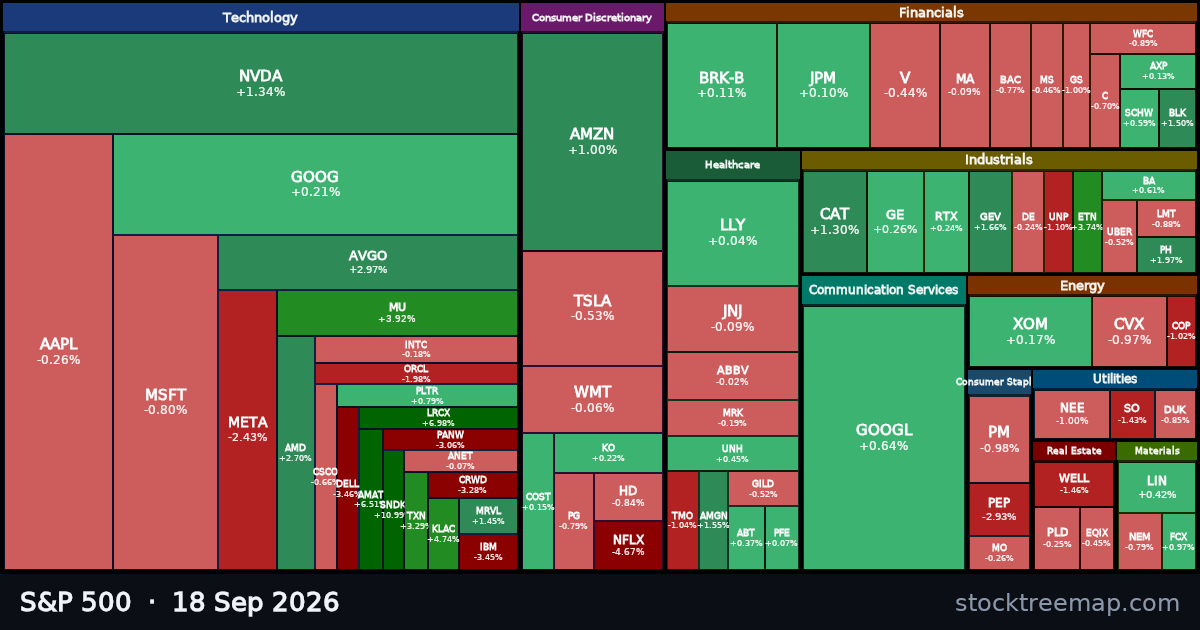
The S&P 500's utilities sector had nowhere to hide on 18 September: all 31 of its members closed lower, a cap-weighted drop of 1.41% that erased $18.5 billion, according to StockTreeMap's own snapshot of the session.
It wasn't alone. Consumer staples fell almost as broadly — 26 of its 30 members closed down, a cap-weighted loss of $17.4 billion (-1.18%) — and real estate saw 27 of 30 names lower, down $11.3 billion (-0.94%). Materials fell nearly as uniformly, with 23 of 25 members lower for a $12.9 billion drop (-1.10%), though that sector's biggest loser, steelmaker $NUE (-6.32%), looks more like a commodity story than a rates one.
| Sector | Cap-weighted change | Dollar change | Breadth |
|---|---|---|---|
| Utilities | -1.41% | -$18.5B | 31 of 31 lower |
| Consumer Staples | -1.18% | -$17.4B | 26 of 30 lower |
| Materials | -1.10% | -$12.9B | 23 of 25 lower |
| Real Estate | -0.94% | -$11.3B | 27 of 30 lower |
| Technology | +0.52% | +$145.2B | 43 of 76 lower |
| S&P 500 (whole index) | +0.15% | +$103.6B | — |
Utilities, real estate and consumer staples are the market's classic bond proxies: steady dividend payers that compete directly with Treasury yields for income-seeking money, and that get less attractive, all else equal, the higher those yields climb. The 10-year Treasury yield reached 5% during Friday's session, a level MarketWatch flagged in its close-of-day market report.
The move built over the week. The Federal Reserve raised interest rates on 16 September for the first time since 2023 and signaled at least one more hike before year-end, CNBC reported. The same day, Fed governor Kevin Warsh said inflation remained "too high," a comment the Wall Street Journal tied directly to a market selloff. By Friday, further remarks from Warsh — described by CNBC as "three words" that left "Wall Street wondering how far the Fed will go with rate hikes" — accompanied the yield's push to 5%.
None of that shows up in the S&P 500's headline number. The index closed up just 0.15% cap-weighted, adding $103.6 billion, because Technology pulled hard in the other direction — even though 43 of its own 76 members fell. The sector's $145.2 billion gain was concentrated in a handful of chipmakers: $NVDA added $70.7 billion (+1.34%), $AVGO added $49.2 billion (+2.97%) and $MU added $43.3 billion (+3.92%), while some of the sector's largest non-chip names moved the other way — $META fell 2.43% ($42.2 billion) and $MSFT fell 0.80% ($29.5 billion).
Count sectors rather than dollars and the day looks even more one-sided. Seven of the S&P 500's eleven sectors closed lower — utilities, consumer staples, materials and real estate hardest, plus smaller declines in consumer discretionary, healthcare and energy. Only technology, industrials (+0.46%, +$24.5 billion), communication services (+0.37%, +$19.6 billion) and financials (+0.11%, +$9.7 billion) closed higher. The index finished positive only because the dollar value concentrated in a few large technology companies outweighed the number of sectors moving the other way.
That split is also why the S&P 500 and the Dow told different stories Friday. CNBC and MarketWatch both reported the Dow fell and closed out its worst week since March, dragged down by the same rate-sensitive names that hit the S&P's defensive sectors — without the chipmakers that offset those losses in the broader index. The treemap above shows both halves of that story on the same map: a wall of red running through utilities, staples and real estate, sitting next to the green concentrated in a small cluster of semiconductor names.
See it on the site
Sources
- Fed approves interest rate hike, signals one more to come this year — CNBC (16 Sep 2026)
- U.S. Markets Sell Off After Fed's Warsh Says Inflation Is Still 'Too High' — The Wall Street Journal (16 Sep 2026)
- Three words from Kevin Warsh have Wall Street wondering how far the Fed will go with rate hikes — CNBC (18 Sep 2026)
- Stock Market on Sept. 18, 2026: S&P 500, Nasdaq end modestly higher, Dow declines as 10-year Treasury yield rises to 5% and oil prices hold at $100 a barrel; Dow books worst week since March — MarketWatch (18 Sep 2026)
- Dow falls Friday and posts worst week since March as Treasury yields rise: Live updates — CNBC (18 Sep 2026)
New posts as they go up: subscribe to the feed, or turn on the market close email.